Annotation paragraphs:
The principle of asceticism and the principle of sympathy and antipathy. I did not understand such terms before reading Jeremy Bentham’s “The Principles of Morals and Legislation.” However, these terms are vital to understanding Bentham’s take on the principle of utility and why he believes it is so important.
Firstly, defining these ideas is crucial to understanding what Bentham is trying to say about utility. Asceticism is living with self-discipline and avoiding indulgences; it is the rejection of pleasure and thus opposes what the principle of utility stands for. Moreover, the principle of sympathy and antipathy is the belief of judging actions right or wrong based solely on personal feelings. This also opposes the principle of utility, for the latter tells what is right or wrong based on the happiness of the people, not one person’s own feelings. These two opposing principles to utilitarianism serve as an opposing force to utility that attacks its rightness, yet Bentham believes utilitarianism is the only right principle to be governed by; hence, any other principle that contradicts it must be wrong: “If the principle of utility be a right principle… whatever principle differs from it in any case must necessarily be a wrong one” (Bentham, pg. 19). These are the two principles Bentham states in order to raise an argument against them to defend his stance on the principle of utilitarianism and its place as the right principle to be governed by.
Consequently, this raises the question, “Does pain (fear) compel people more than pleasure?” According to Bentham, asceticism is followed by two classes of people only: the moralist and the religionist. However, they do so for different reasons. The moralist looks for hope, “the philosophic pride” (Bentham, pg. 20) that comes from rejecting pleasures, while the religionist resolves to asceticism because of fear, “the fear of future punishment at the hands of a splenetic and revengeful deity” (Bentham, pg. 20). Nonetheless, Bentham explains moralists do not fully reject utilitarianism; instead, they reject the materialism that creates pleasure, not pleasure itself. On the other hand, the religionists see the rejection of utility “as a matter of merit and duty” (Bentham, pg 20) that benefits them spiritually. A stark contrast from the moralists who try to keep order and a sense of cleanliness in their lives with the rejection of materialism over the fear of a deity. This reveals the different viewpoints of each group, one that resolves to reject materialism for the sake of staying clean spiritually speaking, and the other that rejects pleasure altogether to satisfy their religious duties so that they do not receive punishments in the afterlife. Thus returning to the central question, in people who believe in and follow asceticism, fear does play a factor that compels their behavior more greatly than pleasure, allowing them the belief to reject the principle of utility, but in some, such as the moralist, it is much less present, for fear is not their deterrent, but the sake of keeping a cleansed soul does overpower the want to enjoy pleasures. Provided Bentham still sees these viewpoints as nuanced and faulty.
Furthermore, I believe the quote “Men of education more frequently… continually open to the attacks of fear” (Bentham, pg. 20) highlights Bentham’s stance on these opposing principles. He believes the moralists do have a somewhat fair reason to reject the principle of utility, while religionists do not. The reason religionists do not have a good standing reason for rejecting utility is due to Bentham believing that the search for purity is not an easy task to identify, and much less to achieve. He believes the religionists are uneducated in this regard and are much more at risk of going along with “the superstitious” (Bentham, pg. 20), for their thinking is very narrow and their knowledge is low. Bentham does not believe the “decorum” to be completely realistic in this group of people, and if it is, it is a very difficult task. This illustrates Bentham’s stance on asceticism as a rather foolish endeavor that does not synergize with his argument for the principle of utility.
Ultimately, these were the main themes and ideas I gathered through my annotations. The key terms of asceticism and the principle of sympathy and antipathy and their definitions clash with the ideology behind utilitarianism; the vital question on fear versus pleasure reveals this dichotomy of thinking and aids in showing Bentham’s thoughts on anti-utilitarian ways of knowing; and lastly, my interpretations of his many quotes help fix Bentham’s ideas together to understand what he is trying to say about asceticism and utility, illustrating his reasoning on what the right way to make decisions truly is.
Bentham, Jeremy. An Introduction to the Principles of Morals and Legislation, Batoche Books, 2000.
An Analysis of Trouillot’s “Silencing the Past” pages 5 and 6
In Michel-Rolph Trouillot’s work “Silencing the Past,” Trouillot writes about the impact of Western societies on non-Western societies as a result of colonialism, specifically in Haiti, and in relation to the stories of the colonized, exploring why colonized perspectives are often limited within the context of slavery. The main topic Trouillot focuses on is how non-Western societies have been silenced in terms of having their viewpoints on events within and outside their societies, such as accounts of their interactions with Western populations, recognized and understood by present-day scholars. It is crucial to note that Trouillot, in accordance with his argument on how Western societies determine whether something happened or not, states there are four ways/ “moments” for an event to be considered as “having occurred” at some point in time, these include: the moment of fact creation, the moment of fact assembly, the moment of fact retrieval, and the moment of retrospective significance, (Trouillot, p.8). These four moments are vital to understanding how Trouillot believes Western societies know about and learn about what occurred in the past.
Trouillot states, “Human beings participate in history both as actors and narrators” (Trouillot, p.5), and this is important to know in order to understand how Western societies were able to silence non-Western societies. It is well known that history is written by the victors, so with this in mind, Trouillot is making this claim where human beings, as actors, participate in events ( events being wars, rebellions, movements, etc) and play a physical role in constructing a historical event. However, as narrators, they give the event meaning; in other words, some way future scholars can make sense of these events and find significance in them. This is important to understand because for a long time Western societies were the victors of colonized societies, and this means present-day scholars know the narratives from the western point of view, but the non-western point of view is silenced. Furthermore, when Trouillot writes “In vernacular use… which is said to have happened,” (Trouillot, p.5), he defines his definition of what the word history means, and this is fruitful to better grasp what it means for a group of people to be silenced. Due to the effects of imperialism and colonization within Haitian societies, the point of view that is best understood by scholars as to what occurred in this region is that of the Western point of view; this is a result of the four moments mentioned earlier. Western societies require physical evidence of events (The moment of fact creation), and having this, along with being the ones who controlled the region for many years, the collection of events that took place in the region is better understood through Western lens, leaving the point of view of the enslaved out of the equation and effectively silenced. History, according to Trouillot, is “ both what happened and that which is said to have happened,” (Trouillot, p.5) hence, through the perspective of the Western societies we know what happened because we have the tangible evidence (the writings/documents) and we know what was said to have happened according to the Western viewpoint because their writings also include the topic of slavery that occurred in Haitian land, yet through the lens of non-Western society there is little to no evidence that satisfies the Western four “moments” that would make their point of view valid, and so, it is silenced.
However, non-Western societies being silenced does not inherently mean their point of view of events does not exist. Trouillot adds, “That such rules are not the same… do not differentiate between fiction and history” (Trouillot, p.6) to illustrate the specific reason non-Western societies were misunderstood by Western societies. Non-Western societies collected and recorded events in different ways than those of Western societies. For example, oral stories were valid ways of collecting events that could be passed down in order to fundamentally keep accounts of events alive and thriving within non-Western societies. Yet, as Trouillot mentions, “Because these observers did not find grammar… promptly concluded that such rules did not exist,” (Trouillot, p.6 ), this effectively demonstrates the direct reason Western societies were able to silence the non-Western societies. These non-Western groups collected events and stories in different ways than those of Western societies, and this was a formidable factor for Western societies to establish dominance over them. The way in which non-Western groups could share their point of view of events was not an acceptable way of recording events, at least according to Western ideology, and what happened in their society or outside of their society, such as when non-Western societies interacted with Western societies, is difficult to know and understand with certainty, as their record keeping of events was different. The imperial nations colonized the non-Western societies, and their point of view of events is therefore better understood, as they have much more evidence (writings/documents) of what occurred in colonized regions. Consequently, understanding colonized perspectives, such as those who were enslaved, is extremely limited, for their accounts of events exist within people themselves as stories rather than writings.
Trouillot’s argument reveals the widespread effect that Western imperialism had on Haitian societies, especially during times of enslavement. The differences in language and record keeping between Western societies and those of the non-Western societies highlights how different narratives can exist for the same events. Trouillot adds “That such rules are not the same in all times and all places” (Trouillot, p.6 ) to reveal how not all societies are similar and, in turn, interpret events according to their own set of rules. Societies being silenced is a result of these differences, but this does not mean that silenced societies do not hold accounts of events that happened around them. With the nature of colonization and Western societies being the victors in most events that include non-Western societies, Trouillot argues that those in power will have their side of the story heard much more than those of the ones that were silenced.
Trouillot, Michel-Rolph. Silencing the past: Power and the Production of History. Beacon Press books, 1995, Massachusetts.
Crafting a Research Proposal and Analyzing a Primary Source
Cover Letter
To the Davidson College Archives & Special Collections,
Hello, my name is Christian Miranda, and my primary interest is in exploring how viewpoints towards learning disabilities have evolved over time in Southern liberal arts colleges. As someone who was diagnosed with a learning disability and received accommodations throughout my K-12 education, I am interested to see how this shift arose from the early 2000s to our present day, as this was the time period I first started attending school.
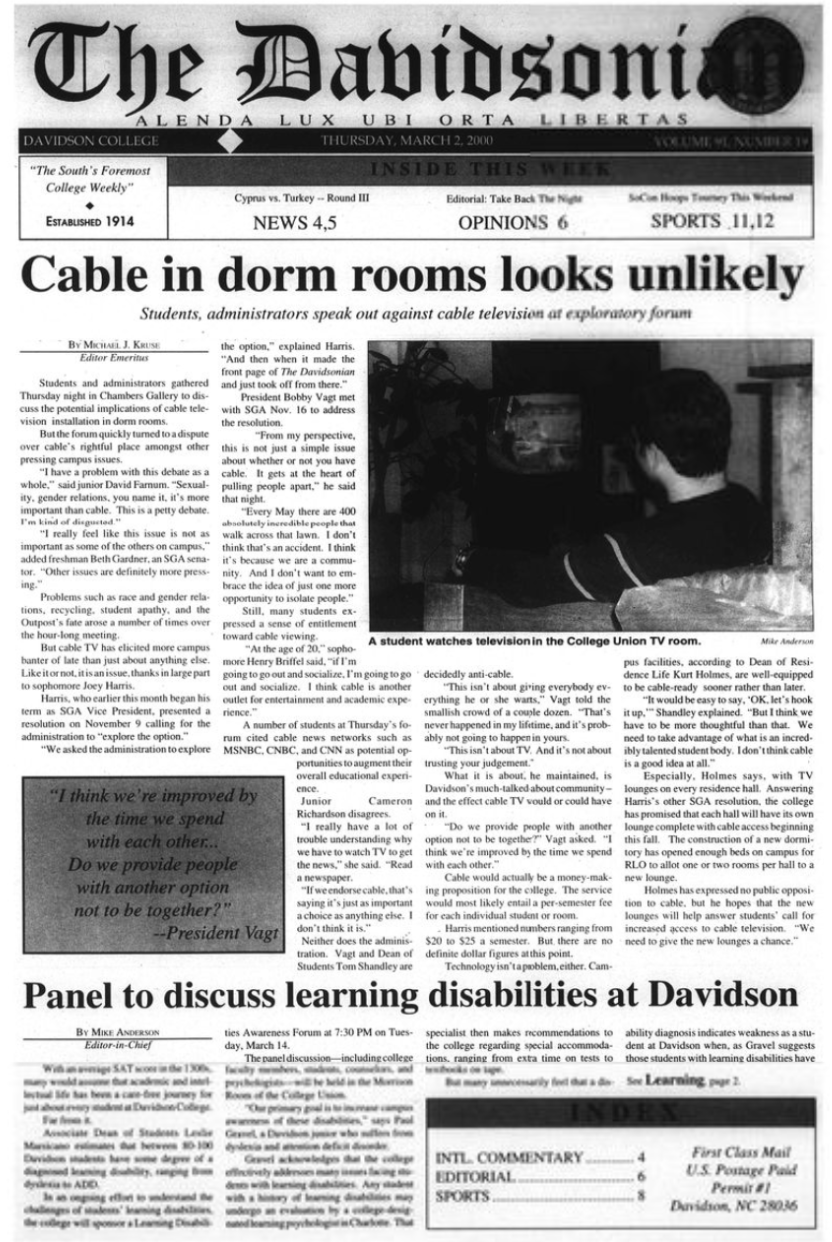
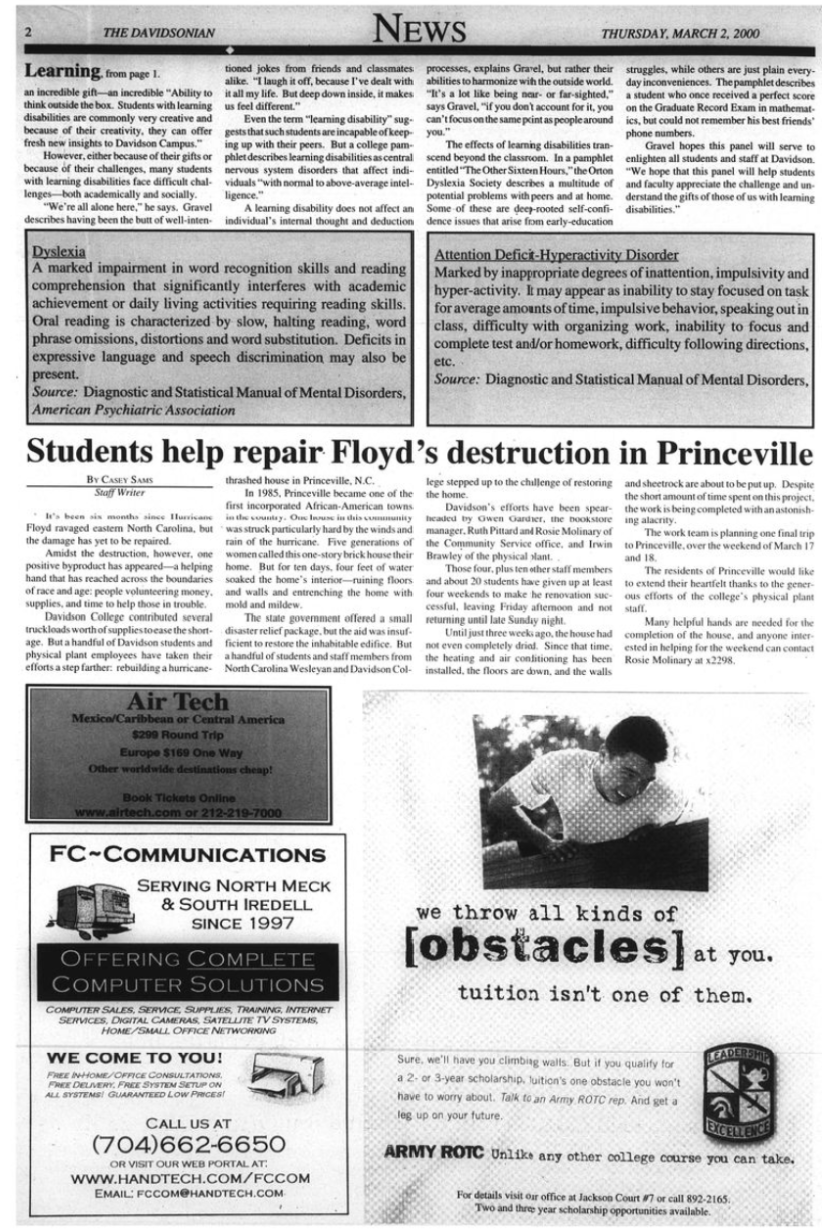
Primarily, I am interested in answering this question: How was the perspective towards students with learning disabilities shifting in southern liberal arts colleges during the early 2000s? I believe that being able to research this will create a solid foundation for me to understand how our current learning disability programs were shaped, and whether this process was universally agreed upon, or if there were any objections to this process. Moreover, I believe this research will uncover historical knowledge not yet extensively studied on how learning disabilities may have been viewed by Davidson College over time, or how Davidson interacted with other southern colleges to address the best way to accommodate and prevent stigmatization of students with learning disabilities. I believe that with the assistance of Davidson’s archives, such as the Davidsonian article published on March 2, 2000 that mentions learning disabilities on campus, can help address how colleges, not only here at Davidson but liberal arts colleges in the south, approached reform in how students with learning disabilities were treated and accommodated within institutions of higher education.
Ultimately, this research could allow a greater understanding of how learning disabilities were viewed here at Davidson, but also in other southern liberal art colleges that may have connections with Davidson in terms of this topic I wish to study. This opportunity, I believe, will uncover knowledge not yet explored but will also open the doors to deeper research on learning disabilities within southern liberal art institutions of higher education.
Sincerely, Christian Miranda
Paper
I have chosen to use a portion of a Davidsonian article as my source for my research proposal. Within this source, I would like to specifically focus on the section of the Davidsonian article that addresses students with learning disabilities and how their differences can be a fruitful way to introduce new ideas to campus. This section explains how students with learning disabilities often are able to “think outside of the box” and offer their personal insights, which can be a great way to bring about change or a new atmosphere to the college. This ideology can be seen as a critical development during the time this article was written, for it exemplifies the need for learning disability awareness in institutions of higher education during the very early 2000s. The article describes students with learning disabilities as “having an incredible gift” that comes with the drawback of being social outcasts on campus. This understanding of how students with learning disabilities were viewed during this time reveals possible developments within educational institutions and society as a whole, viewing students with learning disabilities not as inferiors but as equals on campus who simply view the world through different lenses than the rest of society. This portion of the article attempts to remove the stigma towards those with learning disabilities and attempts to create a much more welcoming environment for those who do have learning disabilities. Moreover, this continued development can be seen in the present day as people with learning disabilities, specifically students in educational institutions, have a greater number of resources to aid their educational endeavors, and the stigmatization towards the population has decreased as awareness has grown for this group of people, creating greater understanding of their situation and needs.
Furthermore, the manner in which this portion of the article is written combines both facts and anecdotes to show how students with learning disabilities may be different but equally gifted as other “normal” students in their own unique manner. The line “with an average SAT score in the 1300s” implies students at Davidson were and are, in fact, intelligent students, even while taking into account those with learning disabilities. It works to highlight how people with learning disabilities can still be very intelligent students despite their additional needs to succeed academically. With the additional quotes from Paul Gravel, a then junior at Davidson who was diagnosed with both dyslexia and ADD, these quotes serve to help understand how students with learning disabilities are very much active members of the community, attempting to bring change and awareness to their situations. This reality allows us to make sense of the ways students with learning disabilities presented themselves on campus and may have been viewed by other students who did not have learning disabilities. It creates this viewpoint other students can see that may shift the negative way students with learning disabilities are viewed on campus. Gravel states “I laugh it off, because I’ve dealt with it all my life. But deep down inside , it makes us feel different” to emphasize the common treatment students with learning disabilities face, such as teasing and jokes. The way in which students with learning disabilities presented themselves as people wanting to bring change to a problem faced at the time works to override the negative viewpoint of students with learning disabilities. It also rewrites this viewpoint to show students with learning disabilities as students who also want to improve the world and use their voices and actions to bring a positive attitude to those who have learning disabilities.
Finally, this portion of the Davidsonian article writes specifically about the circumstances people with learning disabilities experienced in Davidson college, including how they were treated and viewed, but also what they did to attempt to change the narrative on people with learning disabilities from a negative one to a positive one through awareness. Hence, this raises the question: What was done for people with learning disabilities in other colleges? More specifically, how was the narrative/viewpoint towards students with learning disabilities shifting in southern liberal arts colleges during the early 2000s? This question could uncover the different ways liberal arts colleges in the South approached reform in terms of how students with learning disabilities were treated or viewed within an academic setting in the South. It is expected that stigmatization of people with learning disabilities was common in the early 2000s as it was in Davidson college during the same time period (this could be due to a lack of awareness of learning disabilities and how they impacted students). Therefore, it is worth researching the ways other southern liberal art institutions of higher education approached improving how students with learning disabilities were treated but also what they did to become more accessible to this population of people. The amount of services that were provided or created for this group of people could be better explored, or if there were any drawbacks from trying to improve the narrative on people with learning disabilities, additionally, if this transition of reforming the viewpoint on individuals with learning disabilities was a smooth shift? The questions are many, and could uncover how narratives to improve the conditions for people with learning disabilities differed within southern liberal art colleges during the early 2000s.