(Article/chapter presenting a scholarly argument)
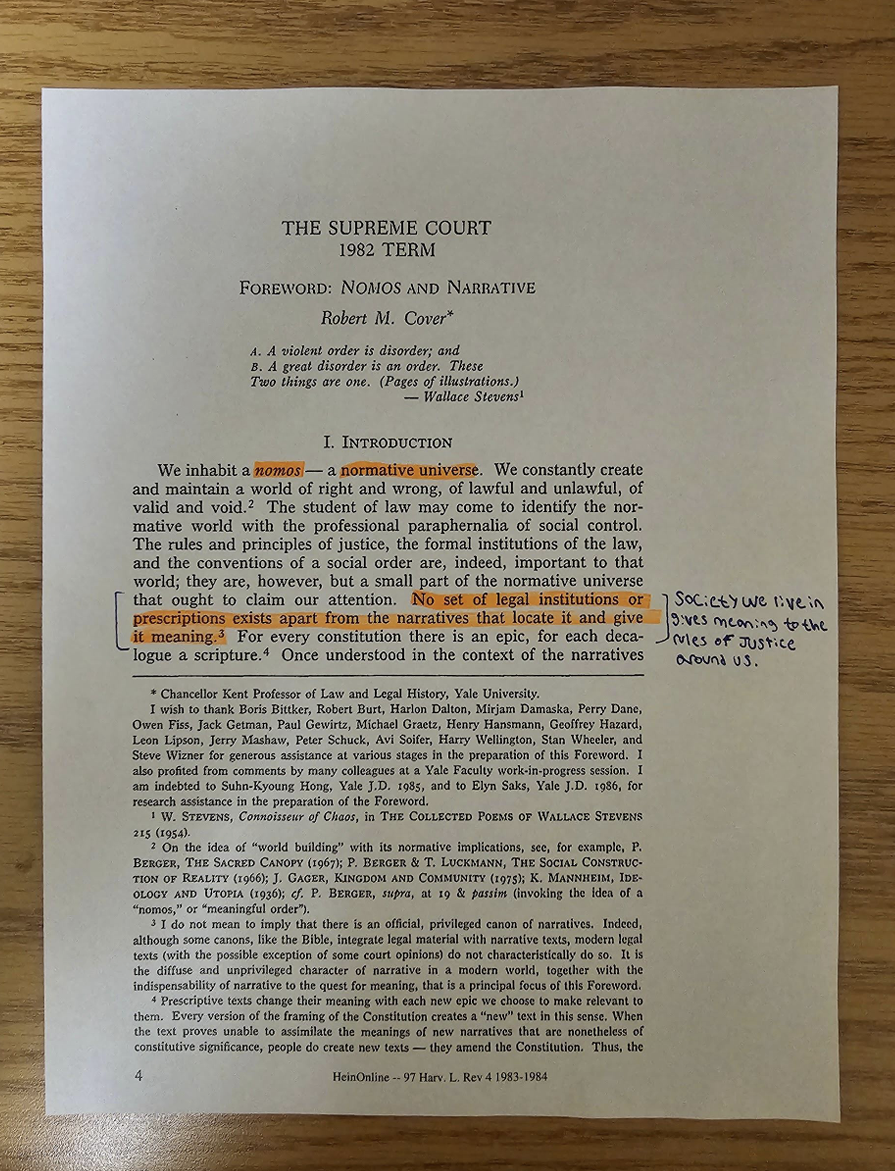
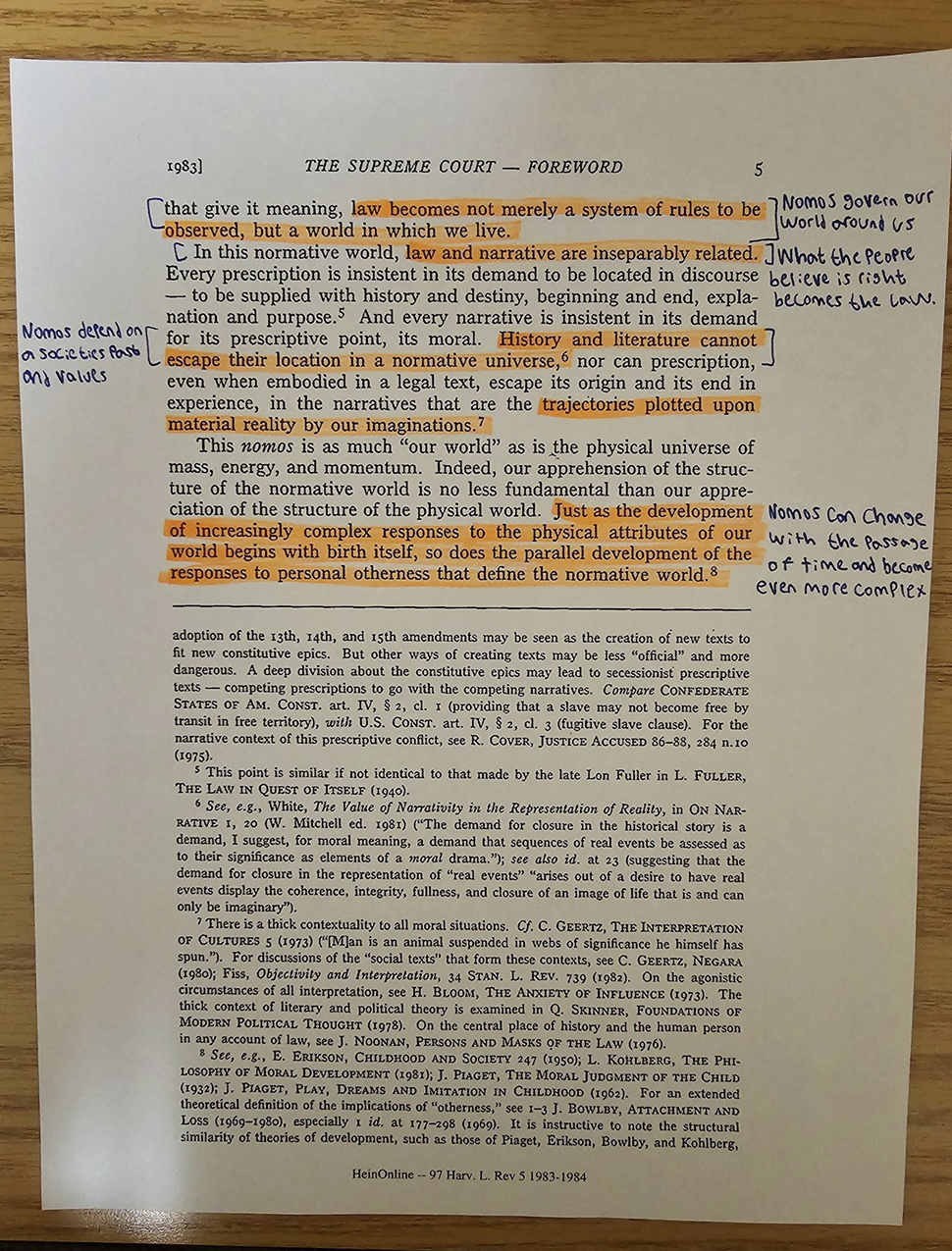
In human societies, there exist nomos, which are societies that share similar values and understandings of how law/justice function around them. Cover states, “No set of legal institutions… and give it meaning” to describe how societies interpret what is fair and what is not fair within their specific nomos. A nomos from a different society will not share the same exact values that another nomos prioritizes in order to achieve fairness and/or order. When Cover adds “Law becomes not… in which we live,” he means a society’s nomos is the governing body of the people who live within it. Law and order are achieved by what the “normative universe” agrees upon in a shared agreement between the people to determine right from wrong. Yet, it is critical to note when Cover writes “Just as the development of… that define the normative world,” nomos are subject to change as societies’ values, morals and beliefs start to shift with the passage of time. This illustrates how nomos may serve as a reflection of a society’s values and what is most important within that society to achieve an agreement of how law/justice should be defined within people’s nomos.
(Article/chapter presenting a philosophical premise)
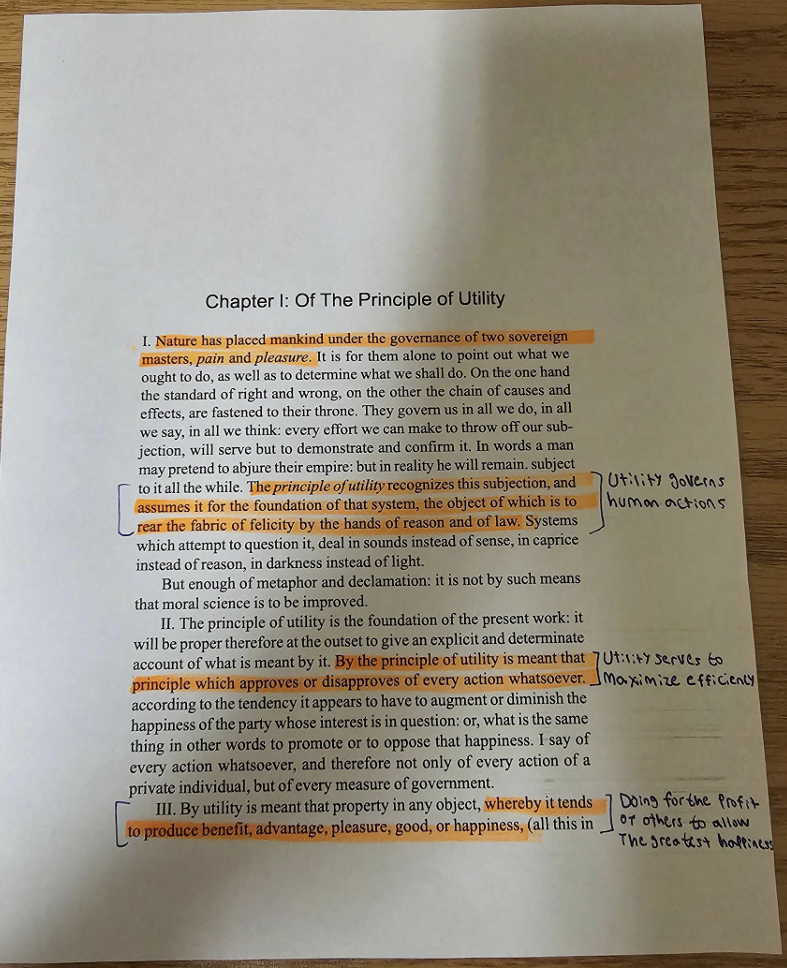
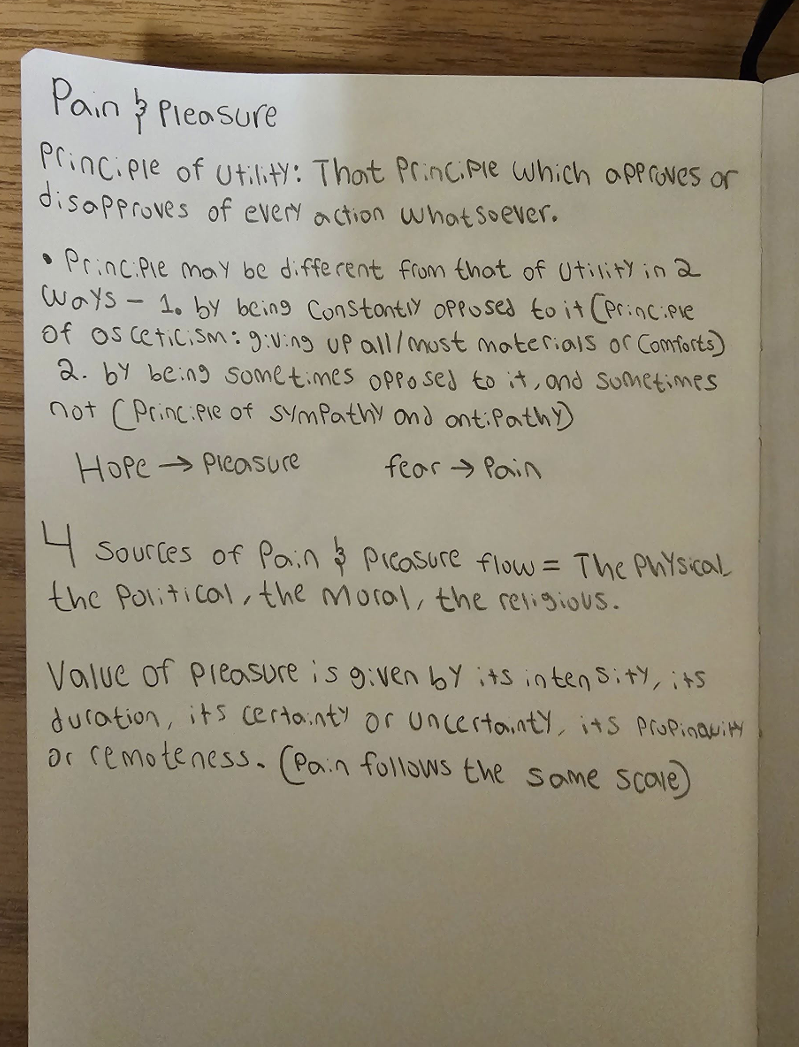
Bentham argues that the principle of utility is grounded in human pain and pleasure to influence decision-making. He claims “The principle of utility recognizes… by the hands of reason and of law” to demonstrate how these two core values (pain and pleasure) are what determine human reason and law. Any other system that does not follow decision making through these two core values is forbidden, as it is an incorrect method of achieving justice. Moreover, Bentham argues that utility is what approves or disapproves of any action, for according to utilitarian beliefs, an action must “produce benefit, advantage, pleasure, good, or happiness” within a society. Under utility, making the most benefit/happiness for the greatest number of people is what promotes a just society. Lastly, the intensity, duration, certainty or uncertainty, and propinquity or remoteness determine the value of that pain or pleasure, which gives it its overall effect on society and how much happiness or pain it can bring to the people within a certain community. This, in a way, quantifies an unquantifiable choice in order to promote fairness and order for a society.
(Poetic response)
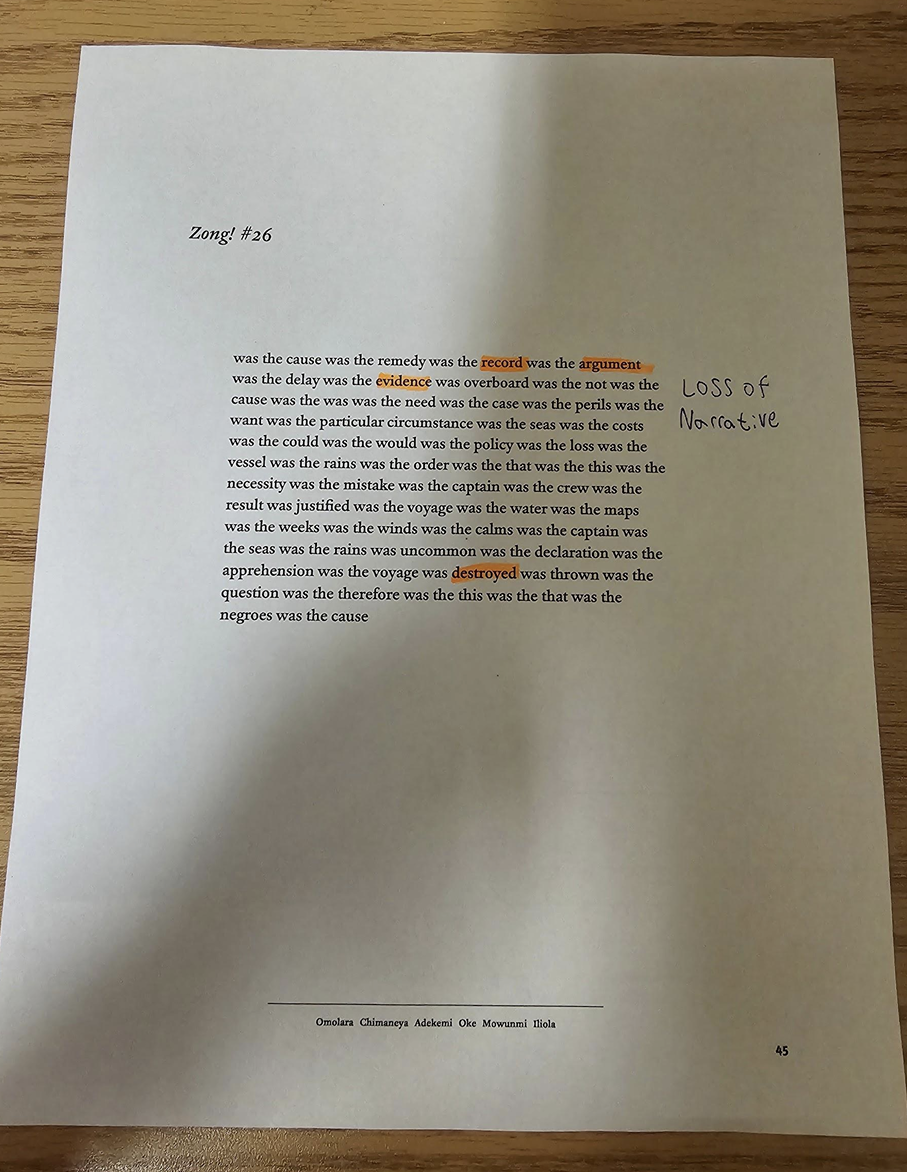
The poem “Zong!” shows the lost narratives of the enslaved who were thrown overboard a British slave ship. The poem was written using the remaining words found within the event’s court case trial that led to little to no justice for the deaths of numerous enslaved people. Words such as “record,” “evidence,” and “destroyed” reflect how the lives and stories of those enslaved within the ship were lost and forgotten. An act of injustice, this tragedy reflects the silencing of narratives that Western nations such as Britain were known for during imperial/enslavement times. The poem’s spontaneous feeling and chaos of wording echoes the suffering and confusion aboard the ship while those enslaved were thrown overboard over the crew members’ errors to manage food and water efficiently. It demonstrates this understanding of what the crew members believed was justified (throwing slaves overboard) and reveals this idea of twisted reasoning that valued money and reputation over people’s lives. The many more chapters that follow get even more unpredictable and chaotic as they represent the increasing terror and suffering onboard while people were thrown to their deaths.
(Article/chapter presenting an historical analysis/documentation)
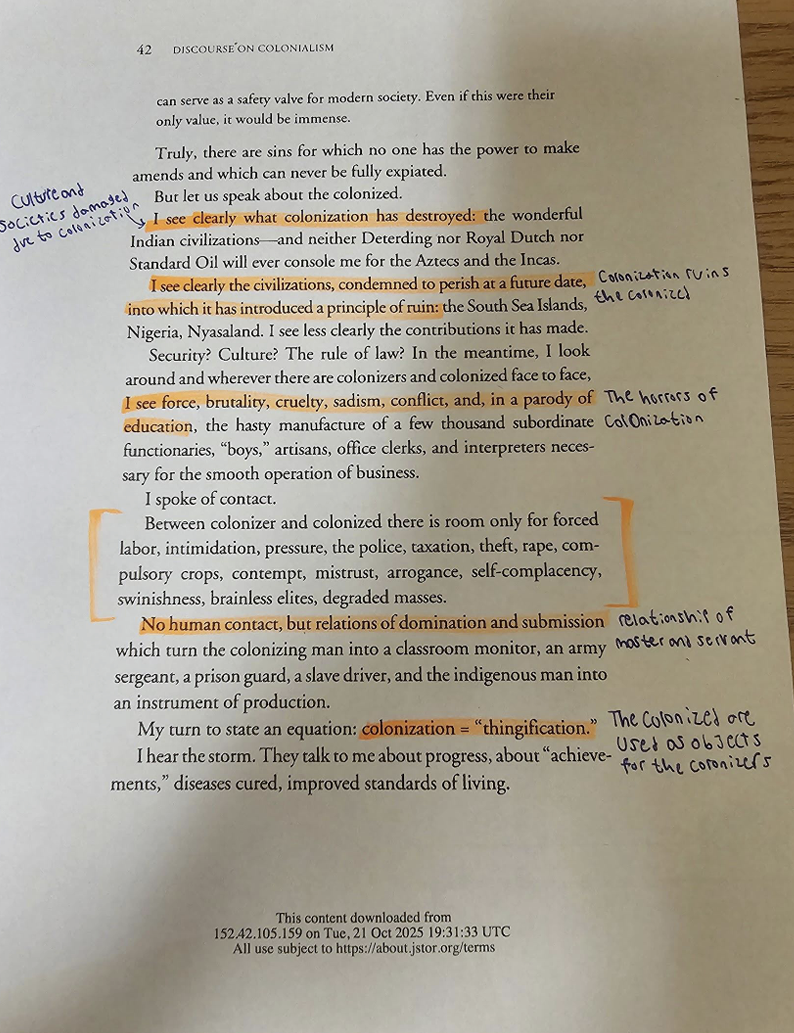
The work “Discourse on Colonialism” by Aimé Césaire highlights the truth of what it meant to be colonized by European nations. Cesaire writes, “I see clearly what colonization has destroyed,” to illustrate how colonization led to the destruction of cultures and established societies. It reveals this “master-servant” ideology where human beings of non-Western origins could be justified in imprisonment and forced labor. The line “No human contact, but relations of domination and submission” supports this “master-servant” theory, where those in power (Western nations) could subject non-Western people to states of exploitation and suffering for the benefit of the Western country. Cesaire’s claim of “Colonization = thingification” demonstrates the key principle behind Western nations’ colonization efforts, as it was an attempt to exploit weaker nations to expand their own empires. From the Western perspective, it was justified, as they would gain from it; yet, justice was skewed in their favor, since Western nations held the power and, therefore, could determine what was right and best for that time period.
(Non-textual reflection)

In the Documentary “Long Night’s Journey into Day,” the search for justice is different compared to the previous works covered. Here, justice is interpreted as finding a way to reconcile with those who have done wrong. Instead of punishment, finding a way to forgive those who have wronged others is investigated as a way to restore peace between victims and perpetrators. It explores this idea of whether justice is an emotional or rational endeavor, where justice is found through emotional aspects such as feelings in order to take away the pain from injustice, or if justice should be rationally found through modern law techniques such as trials, juries, and in the end decide on a punishment that fits the crime. The idea of amnesty is talked about throughout the documentary as a way to give victims of injustice the chance to learn from those who have wronged them or their family, and an opportunity to find a middle ground of forgiveness and a possibility of recovering peace between both parties. The documentary makes a critical point on how justice is not simply the act of punishing wrongdoing but instead finding peace and forgiveness as a way of moving forward from painful events.
(Article/chapter presenting a scholarly argument) (2nd semester)
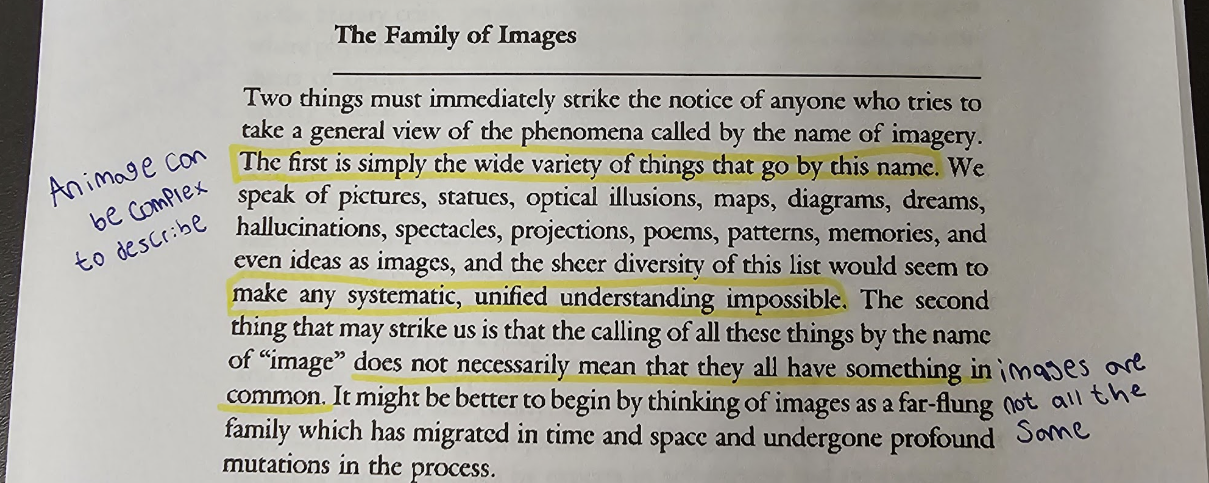
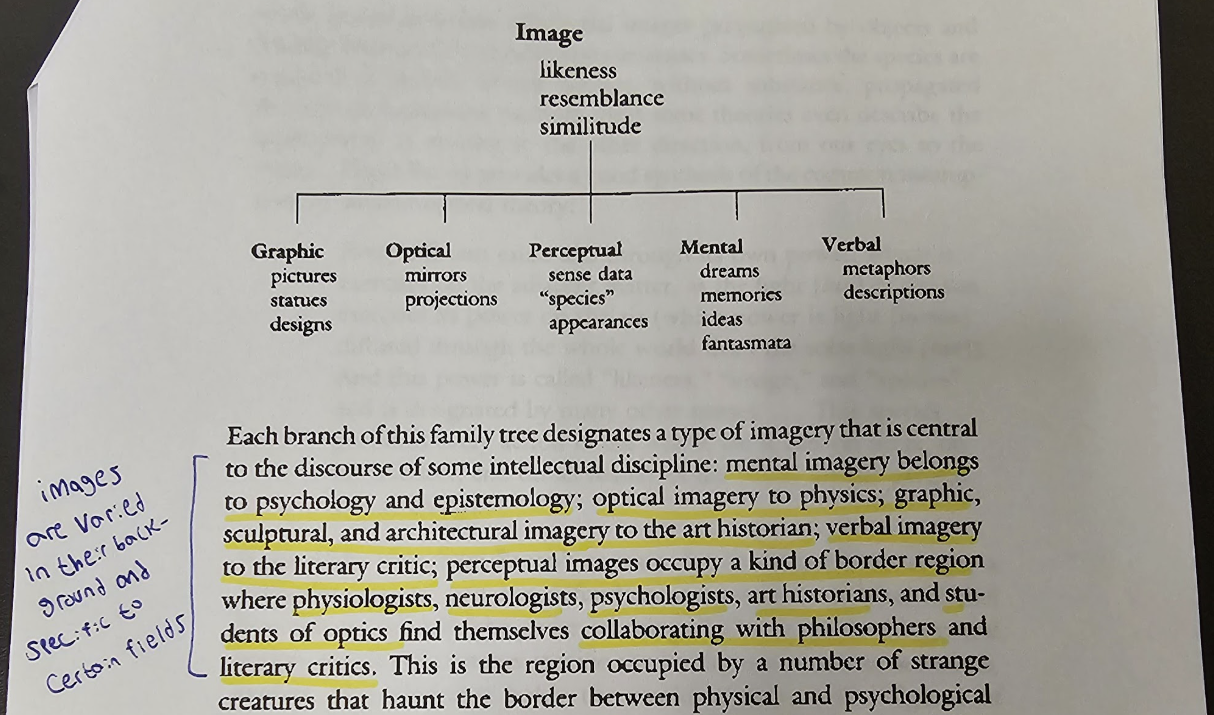
Mitchell’s account of the “family of images” connects to our understanding of justice by showing how images shape how societies interpret truth, authority, and human experience across multiple domains. When Mitchell states “The first is simply the wide variety of things that go by this name” and that “the name of “image” does not necessarily mean that they all have something in common,” he emphasizes that images operate differently depending on their form, such as graphic, optical, perceptual, mental, or verbal types. Each of these forms plays a role in how judgments are made and how power is exercised. Graphic images influence public memory and historical narratives while optical images relate to surveillance, and perceptual images shape assumptions about people in public space. Mental images include the stereotypes that affect legal and social decisions, and verbal images structure the language through which laws and crime are described. By outlining how images function across these varied disciplines and institutions, Mitchell shows that justice is not only a legal matter but also a representational one where the images a society produces and believes in help determine whose experiences are validated, whose are scrutinized, and whose stories are actually heard.
(Article/chapter presenting or discussing a legal argument )
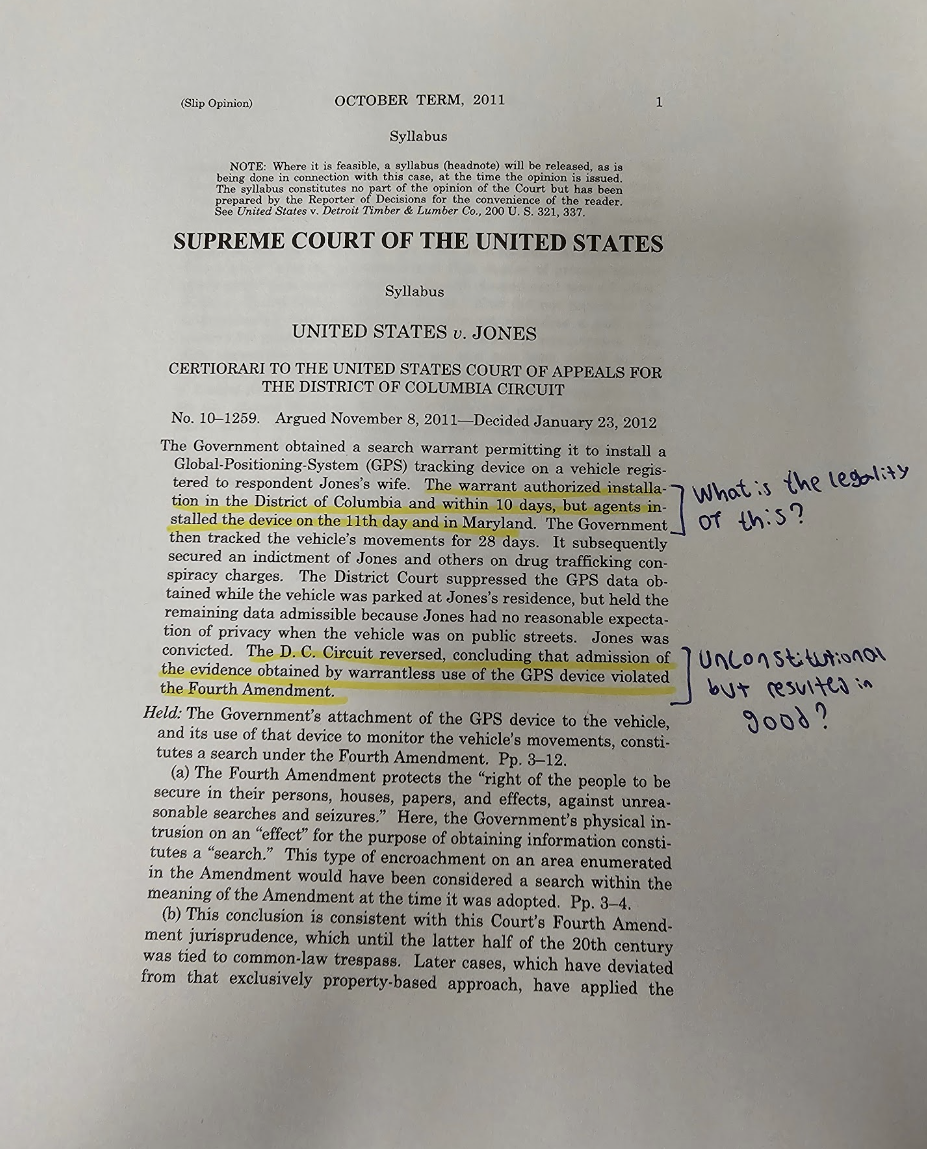
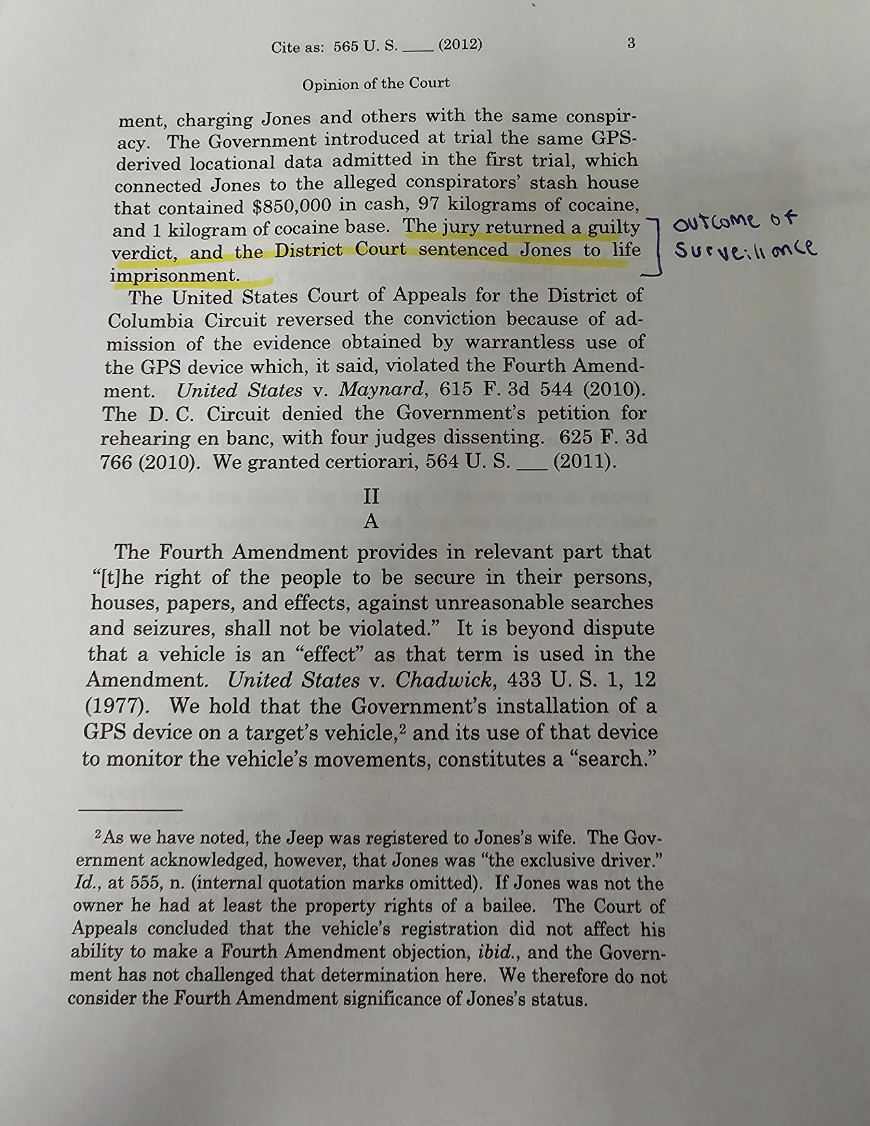
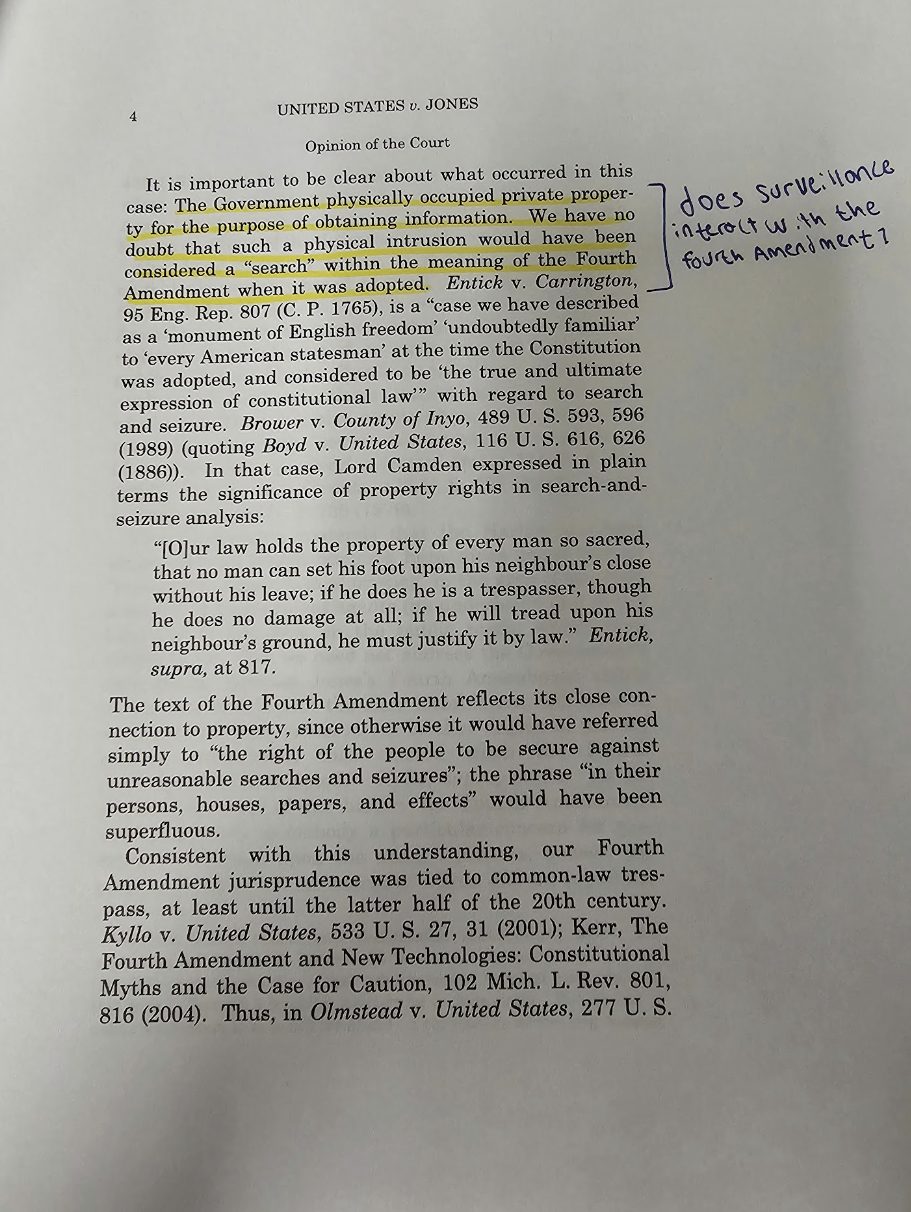
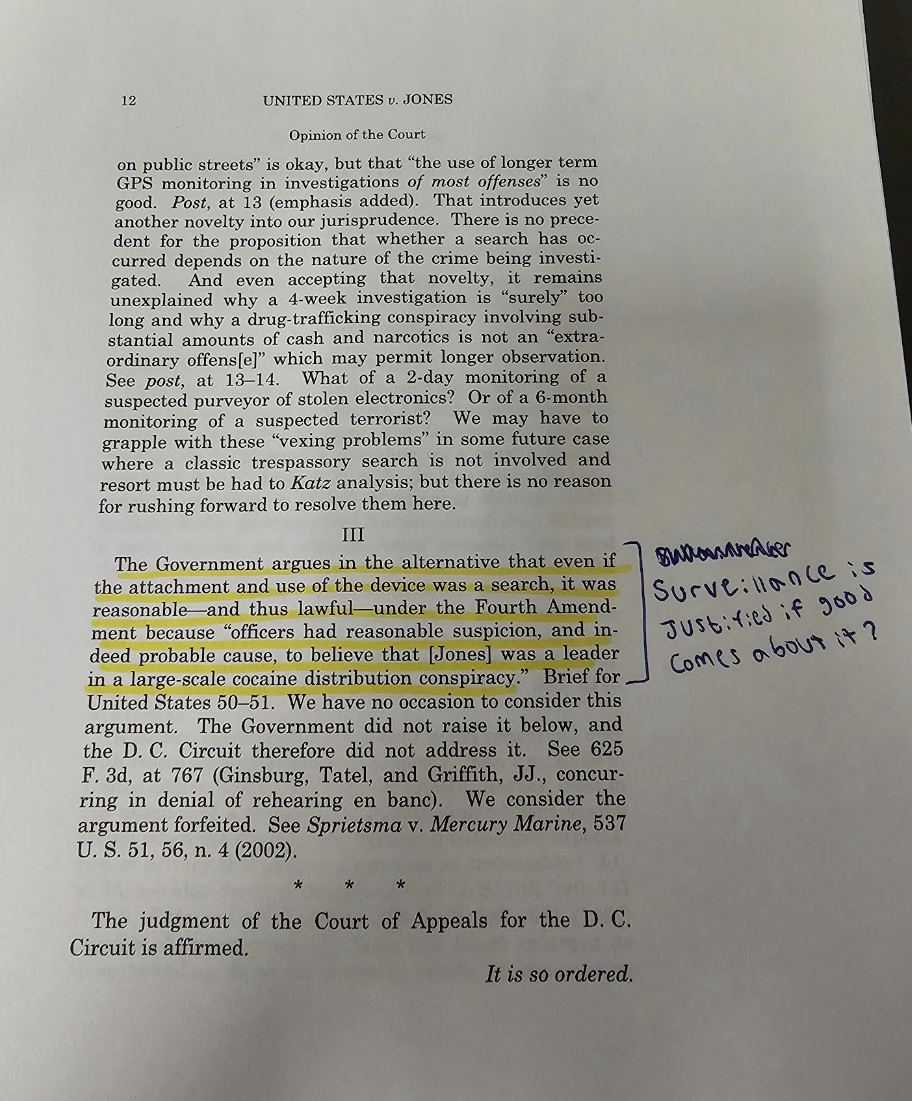
In “United States v. Jones” justice is reflected through how constitutional protections must adapt when state power expands through new forms of surveillance. The Court emphasizes that “the Government physically occupied private property for the purpose of obtaining information,” and that such an intrusion was unquestionably a search under the original meaning of the Fourth Amendment. This depiction ties justice to the protection of personal autonomy and the limits placed on state authority. The case also reveals how surveillance can shape outcomes in how GPS tracking produced evidence that contributed to a life sentence, as seen in the opinion as “the jury returned a guilty verdict… sentenced Jones to life imprisonment.” Justice here becomes a question not only of guilt or innocence but of whether the methods used to obtain the evidence respect constitutional boundaries. The government’s argument that surveillance is justified because it leads to “good” outcomes, such as catching someone believed to be dangerous, raises a deeper justice issue: whether outcomes can override rights. The Court’s rejection of that logic supports that justice requires more than simple effective policing but that it also requires adherence to principles that protect individuals from unchecked state power.
(Article/chapter presenting an historical analysis/documentation)
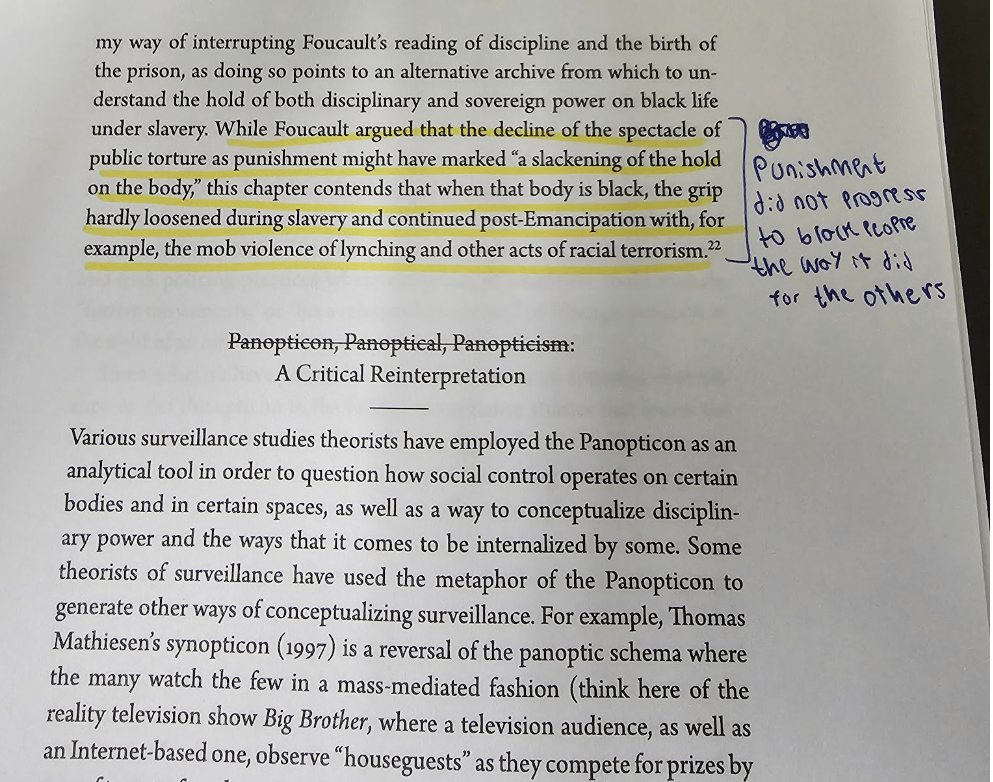
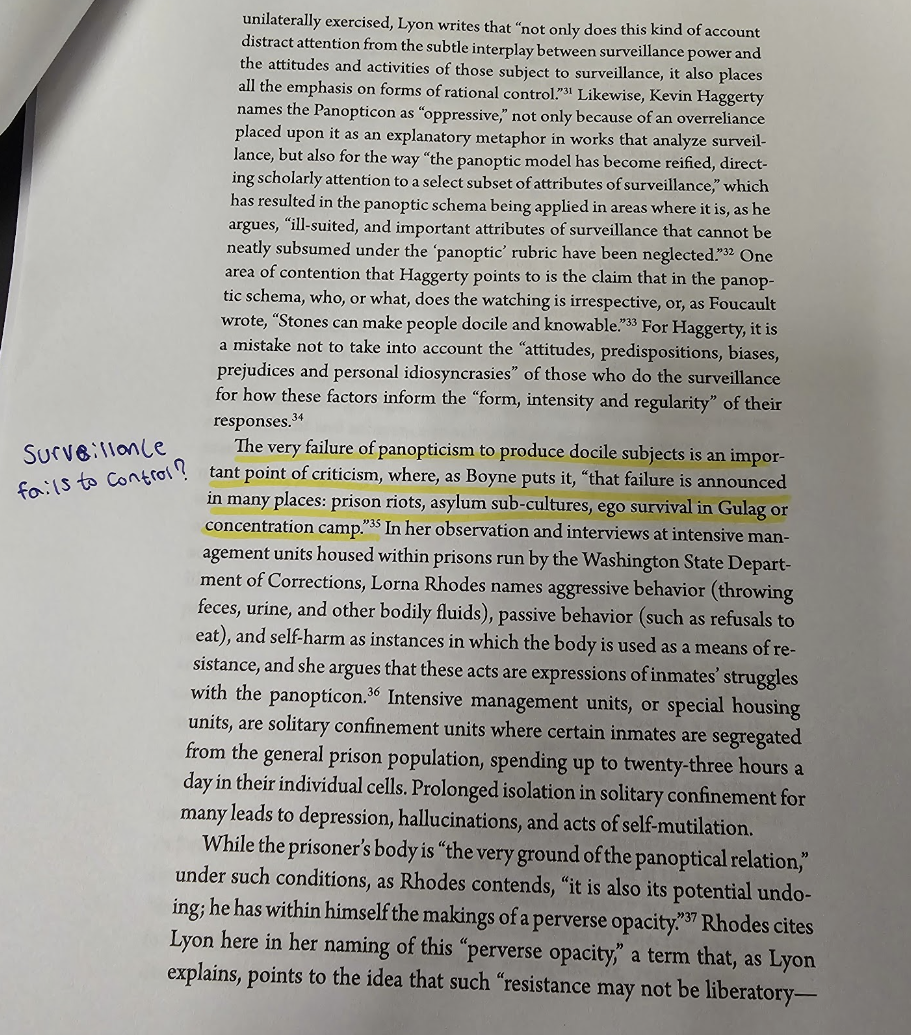
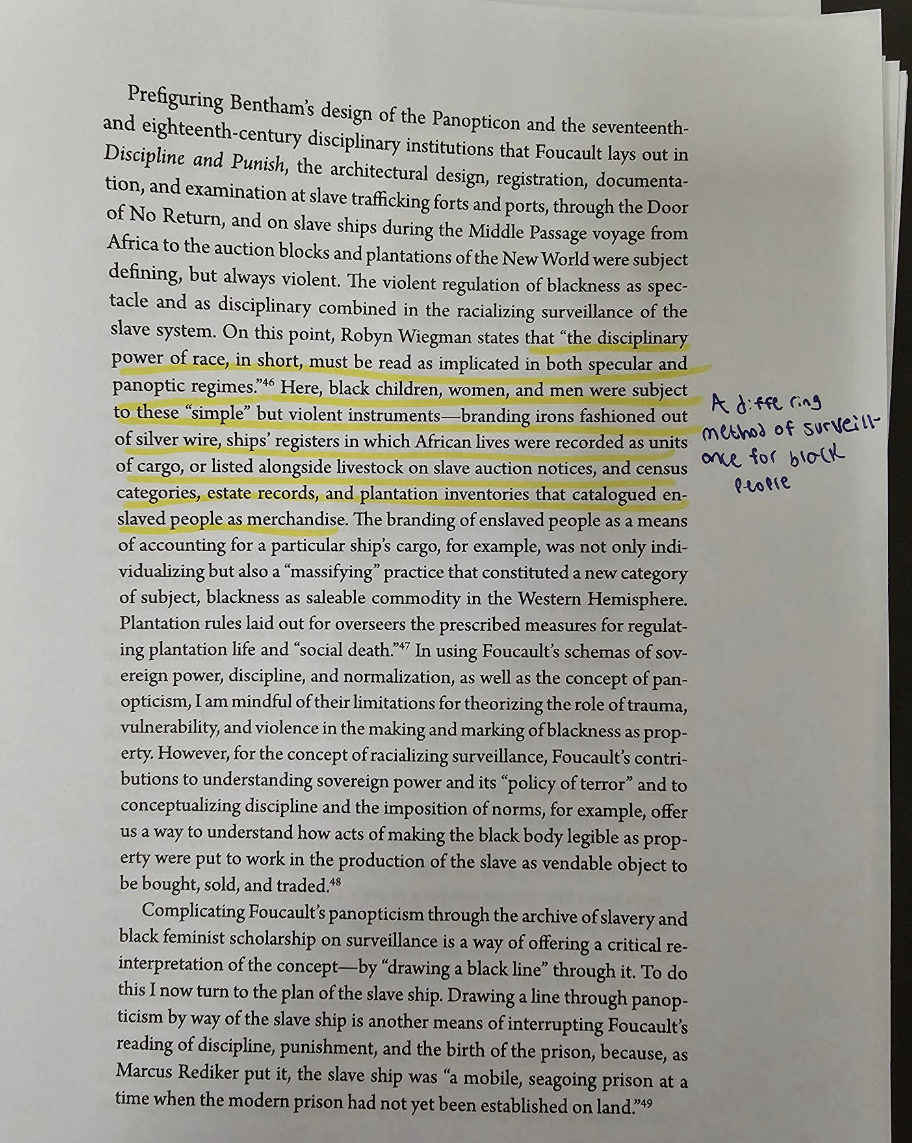
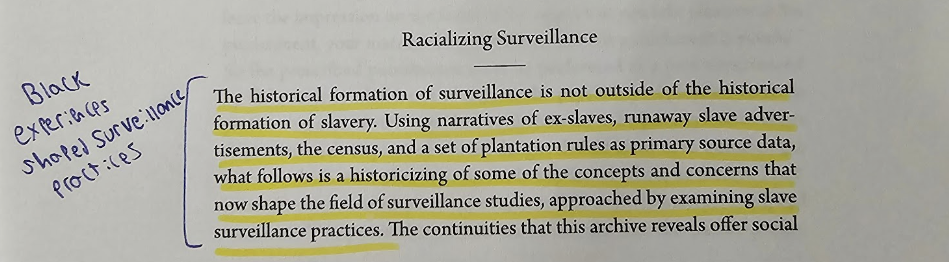
Simone Browne’s work “Dark Matters” connects directly to the theme of justice by showing that modern surveillance practices are built on racial histories that treated black life as something to be monitored and controlled. She argues that modern systems of watching cannot be understood without recognizing how slavery created the foundations of surveillance itself. This is reflected in the highlighted claim “a historicizing of some of the concepts… surveillance studies, approached by examining slave surveillance practices.” Justice, in this viewpoint, is not simply about whether surveillance is legal or effective but instead it is about how surveillance has always been unevenly applied, with black people subjected to forms of control far more invasive and violent than those of the panopticon theory. Browne shows that branding irons, plantation registers, runaway slave ads, and auction notices were all technologies of surveillance that treated Black people as property, not persons. Because these practices shaped the very logic of surveillance, from policing to data collection, they carry forward their racialized assumptions. Justice here then requires understanding how surveillance has historically targeted Black people and recognizing that fairness cannot be achieved without addressing the racial foundations on which these systems were built.
(Non-textual visual artifact /visual artwork)
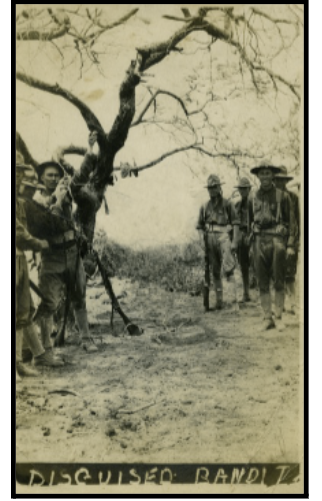
Ken Gonzales‑Day’s “Disguised Bandit” physically depicts its own interpretation of justice by revealing how racial violence has been visually misrepresented and erased in historical artifacts. The photograph, which was originally a lynching image, is part of an archive in which victims were labeled with terms like “bandit,” “outlaw,” or “criminal,” language that justified mob violence and racial terror during the era. Gonzales‑Day’s piece exposes how the crowd and the camera together produced a narrative that made racial violence appear real and serious. By erasing the victim, he highlights the original erasure such as the rejection of the Black victims’ humanity and the transformation of their deaths into a showcase of white authority. Justice, in this context, then becomes a question of how images can shape memory and whose stories are allowed to be seen. The work forces viewers to confront the social and visual aspects that once depicted lynching as an acceptable punishment and asks what it means to repair a history built on misrepresentation and prejudice. Gonzales‑Day’s piece illustrates that justice requires not only acknowledging violence but also observing how the images showed what reinforced it.
(Response to a performance/performance-based practice )
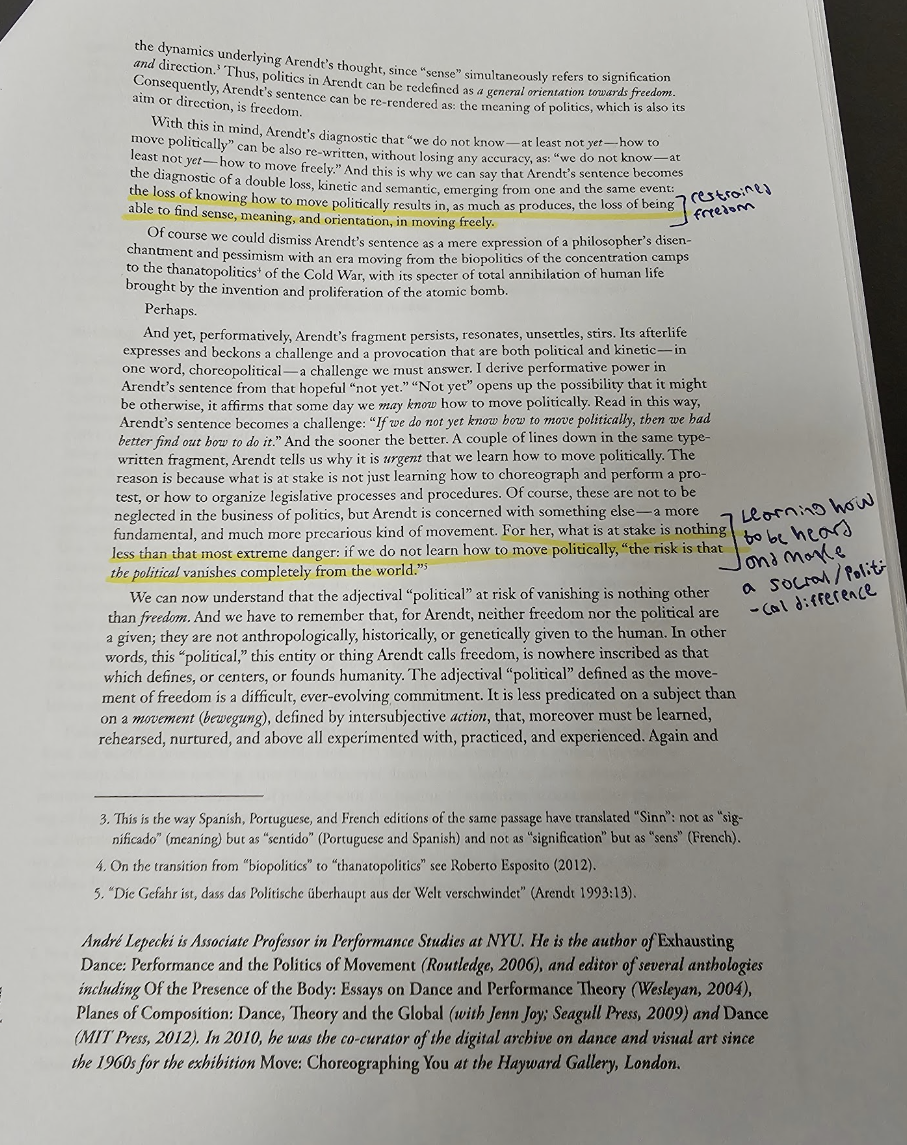
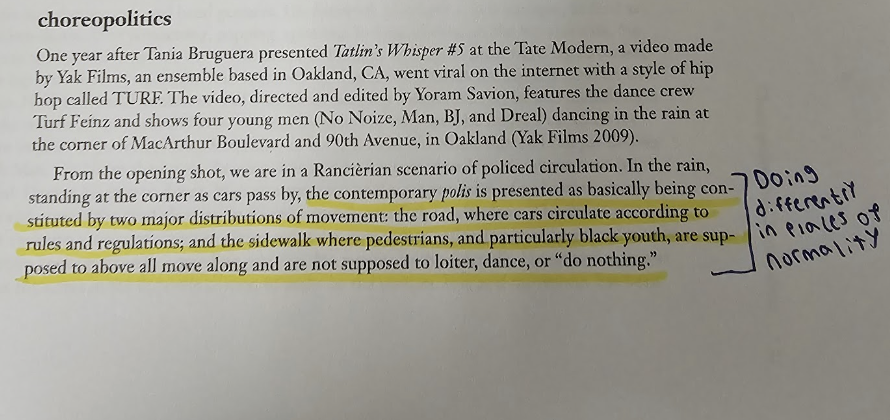
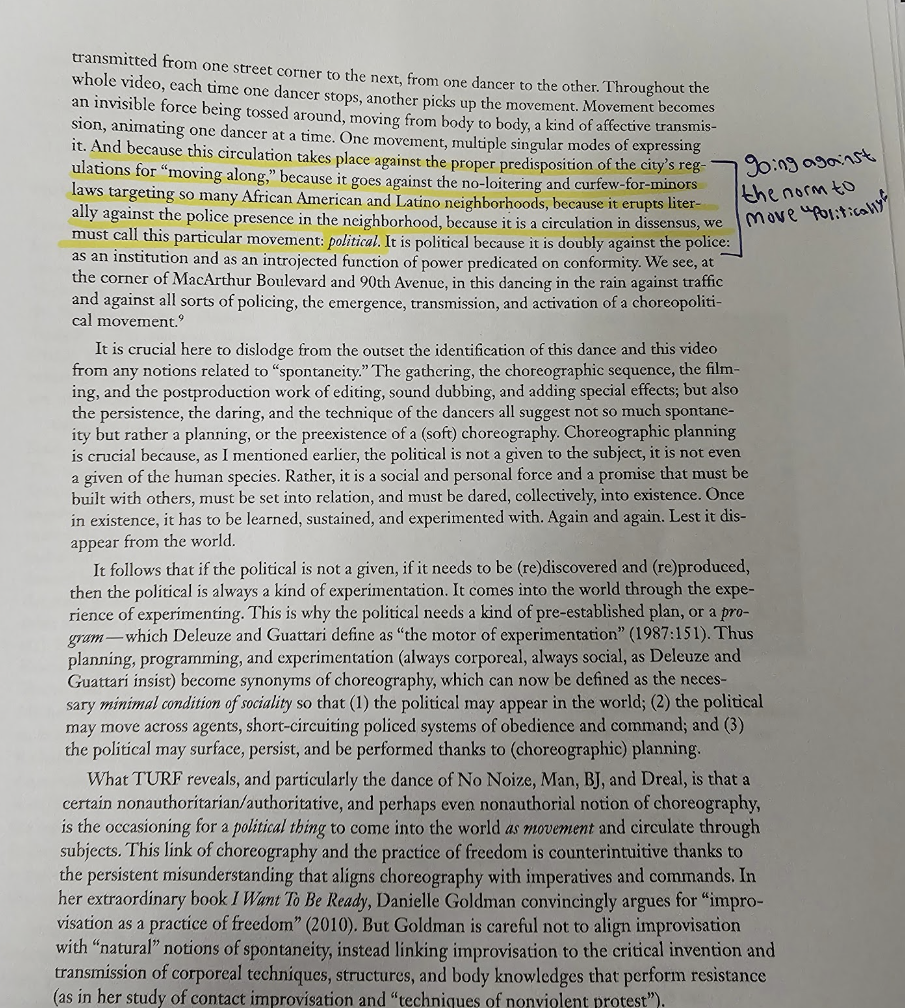
André Lepecki’s “Choreopolice and Choreopolitics” approaches justice by showing how power works through movement and how freedom emerges when bodies refuse to follow established social patterns. He argues that modern policing functions as a kind of choreography that dictates where and how people, especially those from marginalized groups, are allowed to move in public spaces. Lepecki further adds that the city is organized so that pedestrians, “particularly Black youth,” are expected to simply move along and are not permitted to “loiter, dance, or do nothing.” These restrictions reveal that justice is not only about laws, but about who is allowed to appear, gather, and take up space without being treated as a threat. For Lepecki, moments when people move differently, whether through dance or protesting, create what he calls choreopolitics, which are acts that disrupt the “choreography” of control and open up space for political expression. In this sense, justice becomes a matter of reclaiming the right to move freely, to counter the scripted motions of policing, and to assert presence in spaces where certain acts are regularly controlled/regulated.
