Robert Cover’s statement that “no set of legal institutions or prescriptions exists apart from the narratives that locate it and give it meaning” (pg. 4) establishes the foundation to defining justice as a culturally produced system rather than a universal idea. Justice, in Cover’s framing, is inseparable from what he defines as “nomos” which are the assumptions that shape how a society interprets right and wrong. This means that justice is always changing and always reflective of the power structures that determine which narratives dominate society. What one society calls justice may be perceived as violence or domination by another, not because the actions differ, but because the narratives that give them meaning differ. Hence, Cover’s insight reveals that justice is not a neutral category but a product of narrative authority where those who control the story control the meaning of justice itself.
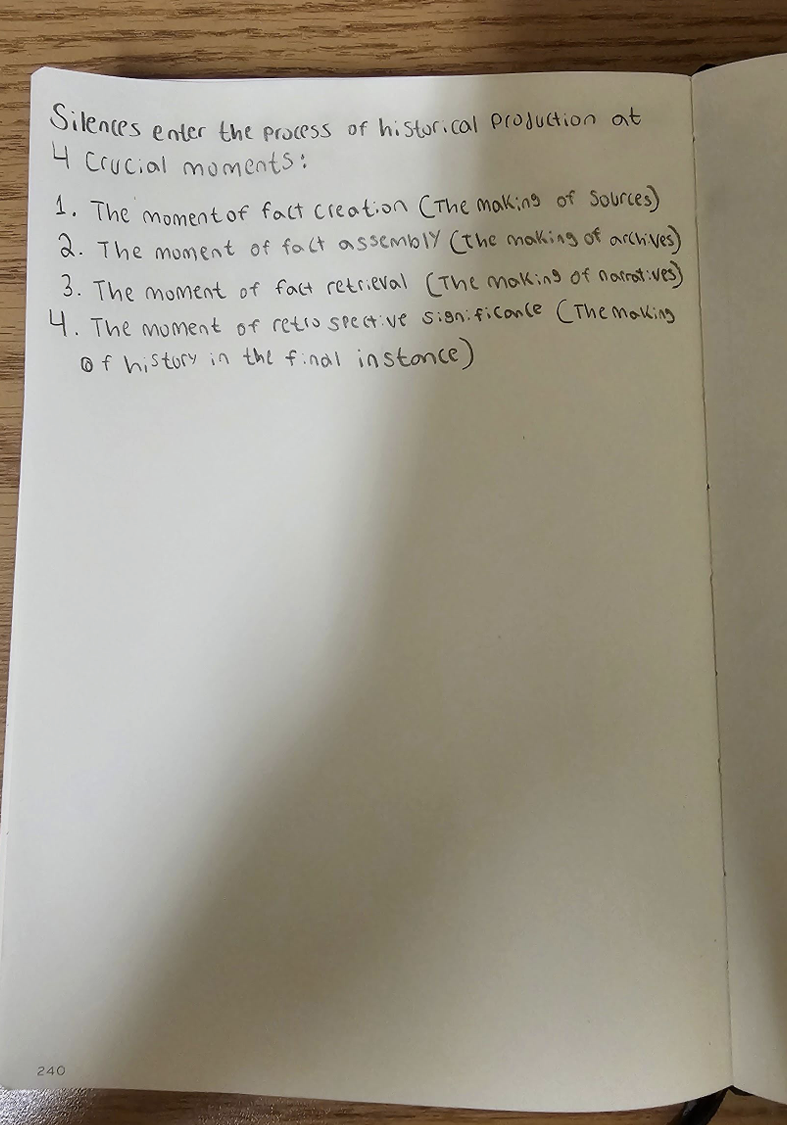
Furthemore, Michel‑Rolph Trouillot’s analysis of historical production reinforces this point by showing how power operates not only through institutions but through the very act of remembering and forgetting. When Trouillot describes how Western observers dismissed Indigenous languages as lacking grammar simply because they could not understand them (pg. 7), he reveals how dominant groups established their own perspectives as objective truths. This dismissal is not only ignorance but also a strategy to justify conquest and domination by revealing the colonized as lacking culture and history. Trouillot’s concept of “silencing” demonstrates that history is not a static record but a changing narrative that is shaped by those with the authority to define what counts as knowledge. In this way, justice plays a part in narrative control where a group’s experiences, languages, or histories are erased, and their claims on justice are erased with them. Trouillot therefore extends Cover’s argument by showing that the narratives that hold legal meaning are themselves produced through unequal distributions of power.
Moreover, Aimé Césaire deepens this understanding by exposing the moral logic that supports colonial domination. His claim that “colonization = thingification” (pg. 42) captures how colonial powers justified violence by reducing entire people to objects, resources to be extracted, bodies to be controlled, and cultures to be erased. This process is not only material but narrative where colonizers construct stories that portray their actions as civilizing and necessary. These stories become the moral foundation of their “nomos”, shaping what they perceive as just. Césaire’s insight reveals that justice, when defined by those in power, often functions as a tool for allowing exploitation. The destruction of other societies becomes acceptable when framed as part of a larger narrative of progress or salvation. This narrative logic even persists after colonial rule, shaping modern understandings of fairness and authority. Césaire thus exposes the relationship between narrative power and moral justification, showing how justice can be weaponized to uphold power.
Next, Marita Sturken’s work on cultural memory further reflects how societies construct justice through selective remembering. Her argument that war memorials overcommemorate only one side of a conflict demonstrates how national identity is built through narratives of suffering and victory. The dead of the opposing side are rarely memorialized, not because their lives lacked value, but because acknowledging their grief would weaken the moral reasoning of the dominant narrative (pg. 68). Sturken’s analysis shows that justice is not only about laws or institutions but about the stories societies choose to tell about themselves. Memorials become physical representations of a common “nomos”, reinforcing a sense of morality that often hides the violence committed in the name of national want. In this way, justice becomes a subject of narrative maintenance where preserving the illusion of righteousness by controlling which histories are visible and which are erased is what is important. Sturken therefore demonstrates that justice is inseparable from cultural memory, and that societies protect their sense of fairness by shaping what they choose to remember and what they choose to forget.
Additionally, Michelle Alexander’s reasoning of mass incarceration in The New Jim Crow demonstrates how these narrative structures persist in modern legal systems. Alexander argues that the criminal justice system constructs a racialized narrative of crime that disproportionately targets black communities and portrays them as inherently dangerous and therefore subject to surveillance, punishment, and exclusion (pg. 46). This narrative functions as a modern extension of Césaire’s “thingification” where the category of the “felon” reduces individuals to objects of control, stripping them of rights and social value. Alexander’s work also echoes Trouillot’s insights about historical silencing, as the causes of racial inequality are hindered by narratives that emphasize personal responsibility and moral failure. In this way, the legal system enforces a “nomos” that appears neutral but is deeply shaped by racial discrimination. Justice, as defined by this system, becomes a way for maintaining social hierarchies rather than challenging them. Alexander therefore provides a modern view of Cover’s argument that law is inseparable from narrative meaning.
Lastly, Simone Browne’s Dark Matters exposes how racialized narratives shape modern practices of surveillance. Browne traces the origins of modern surveillance technologies to the transatlantic slave trade, where black bodies were monitored and controlled as property (pg. 47). She argues that surveillance is not only a simple practice but a narrative one that constructs categories of suspicion and visibility that reflect the racial hierarchies established in the dominant “nomos”. Browne’s analysis complements Sturken’s discussion of grievability by showing how surveillance renders some lives visible as threats while rendering their suffering as invisible. This duality reinforces a narrative in which the security of the dominant group is prioritized over the rights of marginalized communities. Through this, Browne demonstrates that the power to watch is also the power to define who belongs and who is worth protecting. Her work highlights that justice is in fact inseparable from narrative power, where the stories societies tell about safety and danger shape the legal practices that determine who receives justice and who is denied it.
With everything said, we can see that justice is not a fixed or universal concept, but a narrative shaped by power. Cover provides the foundation by showing that law is embedded in narrative through his idea of “nomos”. Trouillot and Césaire expose how historical and colonial narratives shape what counts as just, Sturken illustrates how cultural memory reinforces these narratives, and lastly Fricker, Alexander, and Browne demonstrate how these details persist in present systems of knowledge, punishment, and surveillance. Justice, in this view, is a reflection of the values and power relations that define a society’s nomos. To understand justice, it is therefore crucial to examine not only the laws but the stories that give them meaning, and the many voices that have been silenced in the process.
Cover, Robert M. Nomos and Narrative,Vol. 97:4, Harvard Law Review, 1983, pp. 4.
Trouillot, Michel-Rolph. Silencing the past: Power and the Production of History.Beacon Press books, 1995, pp. 7.
Cesaire, Aime. Discourse on Colonialism. Translated by Joan Pinkham, NYU Press; Monthly Review Press, 2000, pp. 42.
Sturken, Marita. Cultural Memory in the Wake of Violence: Exceptionalism, Vulnerability, and the Grievable Life. Rowman & Littlefield, 2019, pp. 68.
Alexander, Michelle. THE NEW JIM CROW Mass Incarceration in the Age of Colorblindness, The New Press, 2010, pp. 46.
Browne, Simone. Dark Matters, Duke University Press, 2015, pp. 47